St Catherine's Castle

St Catherine's Castle, South West Coast Path, Fowey, Cornwall PL23 1JH, UK
1-99 Years

Description

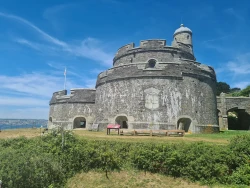
St Catherine’s Castle is one of a pair of small artillery forts built by Henry VIII in the 1530s to defend Fowey Harbour. It was modified in the 19th century during the Crimean War and again during the Second World War, when it became home to an anti-aircraft gun and an ammunition store.

Perched on a rocky promontory at the mouth of the river Fowey, St Catherine’s Castle formed part of a chain of defences built in the reign of Henry VIII (1509–47) in the face of threatened invasion from France and Spain. Its purpose was to prevent seaborne attacks on the important mercantile port of Fowey. 

Free Entry. If you are looking for Best place for day out with kids and families then this is the perfect destination offering fun, adventure, and unforgettable memories for everyone.

Features

  • Free
  • Host birthday parties: No

Features

  • History of St Catherine’s Castle: Perched on a rocky promontory at the mouth of the river Fowey, St Catherine’s Castle formed part of a chain of defences built in the reign of Henry VIII (1509–47) in the face of threatened invasion from France and Spain. Its purpose was to prevent seaborne attacks on the important mercantile port of Fowey.
  • After the initial threat had waned, the castle continued to be used intermittently in response to new dangers. Much later, it was significantly modernised, first between 1855 and 1858 – when it became known as Fowey Battery – and then during the Second World War.
  • The Tudor castle: Early in 1539, Pope Paul III arranged a treaty between Francis I, King of France, and Charles V, the Holy Roman Emperor, temporarily ending years of hostility. He urged them to invade England to punish Henry VIII, who had angered him by divorcing Katherine of Aragon, taking control of the Church in England, and destroying the monasteries of England and Wales, appropriating their lands and revenues.
  • St Catherine’s Chapel: St Catherine’s Point, the headland on which the castle stands, was named after the medieval chapel dedicated to St Catherine that once stood at its highest point. The chapel no longer survives, but was still standing in 1539 when the castle was built. St Catherine was a Christian martyr, executed for her beliefs by order of the Roman emperor Maxentius (r. AD 306–12), and venerated throughout the Middle Ages.
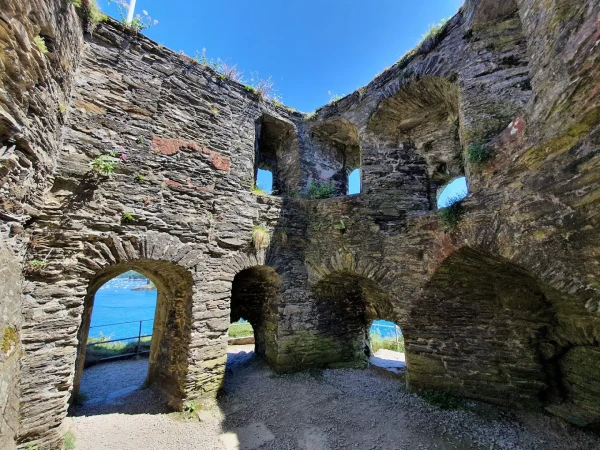
  • The Tudor gun tower: The builders excavated areas of bedrock to create platforms for the fort’s structures, which comprised three main elements: an upper gun tower (the ‘castle’), a gun platform below it (the ‘lower battery’) and a defensive wall. This wall reached right across the headland north-east and south-west from the gun tower, to make the whole castle defensible against a landward attack.
  • The lower gun platform: Below the gun tower, on a lower platform in the rock, is a Victorian gun battery. An 18th-century illustration shows an earlier battery in the same location, and it is likely that there was one here in Tudor times. While the gun tower could only have contained light or medium guns, a lower, open-air battery could have supported heavy guns with a wider field of fire, capable of sinking ships. The battery that fought a Dutch 70-gun frigate in 1666 must have been here.
  • The defensive wall: A stone wall attached to each side of the gun tower, aligned north-east to south-west, separates the castle on the point from the rest of the headland. The wall formed a defensible barrier against attempts to storm the castle from the landward side. It is built on steep slopes and ends on rock faces too severe to climb. Towards its centre point it forms a rectangular projection towards the land: this was probably to enable defenders to fire along the faces of the wall, including the entrance near the north-east end.
  • The castle in action: The castle was probably armed during emergencies in the Tudor era, and also in the First Civil War (1642–6), when Fowey was held in turn by the opposing forces of Parliament and the Crown.
  • War with France: Around 1793, after the outbreak of war between Britain and Revolutionary France, a group of about 60 ‘Battery Men’ formed. They practised on ten old guns which, in 1796, were grouped in three batteries on the west side of the river. Five of these guns were on the lower battery at St Catherine’s Castle and the others in two batteries further upstream.
  • Victorian revival: Fowey Battery: In the early 1850s, there was growing concern about renewed French military expansion and the unpreparedness of British coastal defences. This resulted in re-armament and the building of new defences, including at important mercantile ports such as Fowey.

Facilities

  • Parking: There is a charged car park near to the site managed by Cornwall County Council.
  • Toilets: Public toilets can be found at Ready Money Beach.
  • Dogs: Dogs on leads are welcome.

Price

Price: Free

Birthday Parties

Offer Birthday Parties: No

Open any reasonable time during daylight hours.

Address: St Catherine's Castle, South West Coast Path, Fowey, Cornwall PL23 1JH, UK

Post Code: PL23 1JH

Council: Cornwall

County: Cornwall

  • Road Access: 1 1⁄2 miles SW of Fowey, along a woodland footpath off A3082.
  • Bus Access: The nearest bus stop to St Catherine’s Castle is Tower Park on the route of Bus 25. This is first stop after Readymoney Car Park. St Catherine’s Castle is then a 0.4mile / 0.65km walk. Bus 24 terminates at Fowey Safe Harbour Hotel which is a longer walk of 0.8mile / 1.4kms. Catch Go Cornwall Bus 24 or 25 that run from St Austell Bus Station via Charlestown and Par to Fowey. Mon to Sat: both routes run hourly; Sun & BH: Bus 24 provides the only service, every 90mins. There are regular bus connections at St Austell from Bodmin, Mevagissey, Newquay and Truro.
  • Train Access: The nearest station is Par (4. miles / 7kms). To reach Fowey catch Buses 24 or 25 as detailed above. Note that at Par Station Bus 24 stops directly outside the Station Entrance; for Bus 25 you need to cross the road to the stop opposite the Station Entrance.
  • Bicycle Access: Find this site on The National Cycle Network.
  • Parking: There is a charged car park near to the site managed by Cornwall County Council.

0.00

0 Reviews

Rating breakdown

5
80% Complete (danger)
0
4
80% Complete (danger)
0
3
80% Complete (danger)
0
2
80% Complete (danger)
0
1
80% Complete (danger)
0

Get the best blog stories into your inbox!