Nelson's Column

Description

Nelson’s Column is one of London’s most famous landmarks, standing proudly in Trafalgar Square. The monument honours Admiral Horatio Nelson, who was killed at the Battle of Trafalgar in 1805 during Britain’s victory over French and Spanish forces. Built between 1840 and 1843, it remains a powerful symbol of British naval history and national pride. 

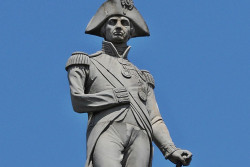
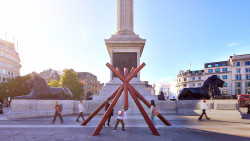
Designed by William Railton, the monument rises to 169 feet (51.59 metres) and is topped with an 18-foot statue of Nelson sculpted by Edward Hodges Baily. The base features four bronze relief panels showing scenes from Nelson’s naval victories, and the column is famously guarded by four large bronze lions designed by Sir Edwin Landseer. Hidden inside is a narrow spiral staircase of 311 steps leading to a small viewing platform, although this is not open to the public. 

It is open to view 24 hours a day and there is no charge to visit, making it a free and accessible historic attraction in the heart of London. 

Located near the National Gallery and St Martin-in-the-Fields, Nelson’s Column continues to be a focal point for visitors and public gatherings. Whether you are exploring Trafalgar Square or learning about Britain’s naval history, this iconic monument is an essential stop when visiting London.

Features

  • Free
  • Host birthday parties: No

Features

  • Nelson’s Column, monument in Trafalgar Square in London. It honours Horatio Nelson, the greatest of English naval heroes, and commemorates Britain’s triumph over France. Lord Nelson was killed at the Battle of Trafalgar in 1805, in which the Royal Navy defeated a combined force of 33 French and Spanish ships, destroying about 20, without itself losing a single ship.
  • The monument, designed by William Railton, was built between 1840 and 1843. Lord Nelson’s statue, 18 feet (5.5 m) high and sculpted of sandstone by Edward Hodges Baily, surveys Trafalgar Square from the top of a fluted granite column, and the entire monument measures 169 feet (51.59 m). 
  • The column is capped by bronze sculptural elements cast from melted cannon from the wreckage of an 18th-century British warship. A few days before the statue was hoisted into place, a party of 14 people ate a perilous steak dinner on top of the column. 
  • The base of the column features four bronze reliefs of Nelson’s naval victories that were added between 1849 and 1854. The monument is guarded at the bottom by four splendidly formidable lions designed by Sir Edwin Landseer and cast by Carlo Marochetti in 1867.
  • Although the square itself has been criticized as a thoroughly incompetent piece of town planning, it keeps its hold on Londoners’ affections and remains high on the agenda of tourists in the capital. Known for its innumerable pigeons, it is often the scene of political demonstrations. 
  • Its history goes back to 1826, when the architect John Nash proposed to clear away a clutter of buildings where the royal mews and stables once stood to create a square at nearby Charing Cross, but it was not constructed until the 1840s, by Sir Charles Barry, architect of the Houses of Parliament. 
  • The fountains and the numerous other statues were added later, but the equestrian statue of Charles I, looking down Whitehall to the scene of his execution, has been there since 1675. The National Gallery on the square’s north side, by William Wilkins, was completed in 1838, several years before the Nelson monument. 
  • The church of St. Martin-in-the-Fields by James Gibbs, occupying the northeast corner of the square and known for its immensely grand Classical portico, was constructed in the 1720s. Nelson's Column features an 18-foot (5.5 metre) statue of Lord Nelson at the top, it symbolises British resilience, maritime power, and the enduring impact of one man’s courage and leadership. 

What to see

Fun facts about Nelson’s Column you probably didn’t know

  • Nelson’s Column was funded through public donations and international contributions, including a significant sum from the Russian Tsar Nicolas I.
  • The total cost of the monument was around £47,000 at the time, which would be more than £5 million today.
  • Hidden inside Nelson’s Column is a tight spiral staircase of 311 steps, winding its way up to a small viewing platform just beneath the statue’s feet. This lofty perch is off-limits to the public, reserved only for maintenance crews and the occasional special-access event.
  • On 23 October 1843, just before Nelson’s statue was hoisted into place, a group of 14 men including stonemasons and dignitaries, scaled the scaffolding to the top of the column for a truly unforgettable meal. With steak and champagne hauled up by pulley, they enjoyed their feast while perched high above London. At the time, it was one of the tallest structures in the city, turning their dinner into both a daring stunt and a celebratory toast to the monument’s completion.
  • Despite its age, the column has withstood the test of time and even nature. In 1896, it was struck by lightning, with Nelson’s statue sustaining only a minor chip on the left shoulder. Ironically, he had already lost the use of his right arm in real life, so this sparked jokes that he might lose the other one too.
  • During World War II, Adolf Hitler planned to relocate Nelson’s Column to Berlin had Germany succeeded in invading Britain, highlighting its symbolic importance.
  • It's located a short distance from Britain's smallest police station in the south-east corner of Trafalgar Square. It was built in 1926 to discreetly monitor protests and is hidden inside a lamppost with space for just one officer or two prisoners at most.
  • Nelson's Column underwent restoration and refurbishment work in 2006, at a cost of £420,000.

Price

Price: Free

Birthday Parties

Offer Birthday Parties: No

Open 24 hours

Address: Nelson's Column, London, UK

Post Code: WC2N 5DN

Council: Westminster

County: Greater London

5

0 Reviews

Rating breakdown

5
80% Complete (danger)
0
4
80% Complete (danger)
0
3
80% Complete (danger)
0
2
80% Complete (danger)
0
1
80% Complete (danger)
0

More Day Outs in City of Westminster

Get the best blog stories into your inbox!