Winchester Palace

Description

Winchester Palace was once one of the largest and most important buildings in all of medieval London. Built in the early 13th century as a home to the powerful Bishops of Winchester, the palace was mostly destroyed by fire in 1814.

Today visitors can see the impressive architecture of the remaining walls of the Great Hall, including a magnificent rose window that adorns the west gable. Winchester Palace is managed by Bankside Open Spaces Trust, which has planted a medieval-style garden in the remains of the Great Hall. 

Free Entry. If you are looking for Best place for day out with kids and families then this is the perfect destination offering fun, adventure, and unforgettable memories for everyone.

Features

  • Free
  • Host birthday parties: No

Features

  • History of Winchester Palace: A few walls are all that remain of the palace of the powerful Bishops of Winchester, one of the largest and most important buildings in medieval London.
  • The Great Hall: Founded in the 12th century by Bishop Henry of Blois, brother of King Stephen, Winchester Palace was built to house the bishops in comfort when staying in London on royal or administrative business.
  • The remains were part of the great hall, which formally stood alongside the south bank of the Thames. The gable wall of the hall has doors which led to the buttery, pantry and kitchen, and it has a magnificent rose window.
  • Below the hall was a vaulted cellar, where goods such as wine could be stored, with a passage to the river wharf. The hall would have been lavishly decorated, and was often used to entertain royal guests, such as James I of Scotland and Joan Beaufort, who held their wedding feast here in 1424.
  • Loss and Rediscovery: The rest of the palace was arranged around two courtyards, and housed many buildings, including a prison, brew-house and butchery. As the bishop’s private retreat from the stresses of medieval governance, the palace also had a tennis court, bowling alley and pleasure gardens.
  • The palace remained in use until the 17th century, when it was divided into tenements and warehouses. The ruins were rediscovered in the 19th century following a fire, and were finally revealed in the 1980s during redevelopment of the area

Facilities

  • Parking: There is no car park at Winchester Palace and very limited metered on-street parking in Park Street, Southwark Street and just off St Thomas' Street, or in Jubilee Place at Borough Market. Please be aware the site is in the Congestion Charging Zone.
  • Toilets: The nearest public toilets are at Borough Market, either in Jubilee Place or in Market Hall.

Price

Price: Free

Birthday Parties

Offer Birthday Parties: No

Open to view at any time. No access to the interior.

Address: Clink Street, London SE1 9DG, UK

Post Code: SE1 9DG

Council: Southwark

County: Greater London

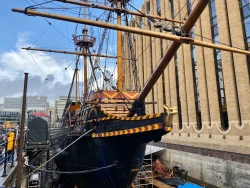
  • Road Access: Next to Southwark Cathedral and the Golden Hinde replica ship; corner of Clink St and Stoney St, SE1.
  • Train Access: London Bridge 1⁄4 mile.
  • Bus Access: From surrounding areas.
  • Bicycle Access: Find this site on The National Cycle Network.
  • Parking: There is no car park at Winchester Palace and very limited metered on-street parking in Park Street, Southwark Street and just off St Thomas' Street, or in Jubilee Place at Borough Market. Please be aware the site is in the Congestion Charging Zone.

0.00

0 Reviews

Rating breakdown

5
80% Complete (danger)
0
4
80% Complete (danger)
0
3
80% Complete (danger)
0
2
80% Complete (danger)
0
1
80% Complete (danger)
0

Get the best blog stories into your inbox!