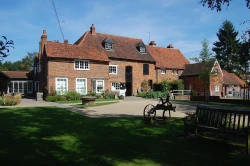
Hatfield House

Hatfield Park, Hatfield, Hertfordshire, AL9 5NQ, England
1-90 Years
Paid

Description

Hatfield House is a historic estate set within protected parkland, offering a unique space to explore history, gardens and nature. The site combines a grand Jacobean house with beautifully designed gardens and woodland areas. It provides an inspiring setting where visitors can discover heritage, architecture and scenic landscapes.

Visitors can explore the House including rooms such as The Marble Hall, King James Drawing Room, Long Gallery, Library, Chapel, Armoury and Victorian Kitchen, along with famous artworks like The Rainbow Portrait. The gardens feature the West Garden, East Garden, Old Palace Garden, Woodland Garden and Renaissance water sculpture, while the park offers woodland walks, veteran trees and a deer park. Activities include walking trails through historic woodlands and exploring landscaped gardens across the estate.

Ticket prices vary depending on access, with Garden, Park & Woodland Walks priced at £17 for adults and £8.50 for children, and Hatfield House, Garden & Park tickets at £27 for adults and £13.50 for children. Family tickets range from £42 to £72, season tickets cost £86 for adults and £44 for children, and The Old Palace Tour is £8.50 for both adults and children.

Overall, Hatfield House offers a rich experience combining history, art and nature in one destination. With its grand interiors, beautifully maintained gardens and expansive parkland, it provides something for visitors of all ages. It is an ideal place to enjoy a full day of exploration, relaxation and learning.

Features

  • Paid
  • Host birthday parties: No

Features

Explore The House

  • The Rainbow Portrait: Perhaps the most colourful Tudor portrait, full of inventive iconography. Elizabeth holds a rainbow with the inscription “Non sine sole iris”, “No rainbow without the sun”, reminding viewers only the Queen’s wisdom can ensure peace and prosperity.
  • The Marble Hall: With its wonderfully extravagant oak carving by John Bucke, the Marble Hall remains much as Robert Cecil, the 1st Earl of Salisbury, built it in 1611. Sometimes used as a dining room, it is the place where the Salisburys would entertain their guests with lavish banquets, dances and masques. The room takes its name from the chequered black and white marble floor.
  • The King James Drawing Room: It takes its name from the life-size statue of James I, presented by the King himself, which stands above the mantelpiece. It is made from stone, painted to look like bronze. The marble chimneypiece was carved by the King’s Master Sculptor, Maximilian Colt (d.1649). When King James I visited Hatfield in 1611, the room was hung with six tapestries telling the story of Hannibal and Scipio. Today’s visitors can see more recently acquired tapestries that have been installed as a background to the many splendid pictures, one of which is the famous Ermine portrait of Queen Elizabeth I.
  • The Long Gallery: This one now runs the entire length of the South Front, having been lengthened to 170 feet (51.8 m) in 1781. The rooms at each end were opened up by the removal of party walls and the insertion of tall, wooden pillars. The ceiling, originally white, was covered with gold leaf by the 2nd Marquess who had been impressed by a gold ceiling he had seen in Venice.
  • The Library: The room occupies the site of the original Great and Withdrawing Chambers on the west side of the House. In contrast, the rooms on the east side were reserved for the King. The Library was formed in about 1782, when the dividing wall between the two rooms was removed. The rebuilt chimneypiece incorporates a remarkable mosaic portrait of Robert Cecil which was made in Venice and presented as a gift to him in 1608.
  • The Chapel: The stained glass window, showing Old Testament scenes, was made in 1610 by the glass-painters Richard Butler of Southwark, ‘Lewis Dolphin, a French painter’ (probably Louis Dauphin) and Martin van Bentheim of Emden, Holland. The scenes depicted, starting at the top and looking from left to right, are as follows: Visit of the Angel to Abraham; Moses in the bulrushes; Solomon and the Queen of Sheba; Jacob’s dream; Jonah and the whale; Passover of the Israelites; Samson and Delilah; Abraham offering up Isaac; Naaman in the River Jordan; David and Goliath; Elisha raising the son of the Shunamite woman; and Elijah in the fiery chariot.
  • The Armoury: The Armoury began as an open loggia in the Italian Renaissance style, with a door at the top of the steps at each end. Such an arrangement proved inconvenient, as it meant that there was no interior passage on the ground floor between the two wings. The 2nd Marquess filled in the windows in 1834 and laid the marble floor. The 3rd Marquess completed the alterations by putting up the panelling.
  • The Victorian Kitchen: The Kitchen was in use from 1611 until the outbreak of the Second World War in 1939 when the House offered by the 4th Marquess of Salisbury for use as an army hospital. The fireplace is original. The range, however, has been reclaimed from a Cheshire castle in order to complete the feel of the Kitchen. Many of the items here are original to the House including all the copper, which has been restored to its former glory.

Explore The Garden

  • Renaissance: This magnificent water sculpture was designed by one of Britain’s most prolific sculptors, Angela Conner, and was installed on the North Front of Hatfield House in 2015. Whilst vast in scale and impressive in material, Conner’s work is characterised by the contrasting simplicity of the mechanic she engineers specifically to realise the mobile aspects of each design.
  • The West Garden: The West Garden is centred on the historic Old Palace, where Elizabeth I held her first council as Queen. At its heart lies the Lady Gwendolen Garden, an elegant parterre designed by Lady Gwendolen Cecil, featuring intricate planting, roses, clematis and sculpted yew topiary that reflect the architecture of the House. The garden leads on to the Sundial Garden and the Holly Walk, which extends into the peaceful Woodland Garden beyond.
  • Stone Frieze of Queen Elizabeth: Taken from the facade of the Royal Exchange after a fire and brought to Hatfield in 1855.
  • The East Garden: Located on the private side of the House, the East Garden combines formal and informal features, including parterres, topiary and rare plants. Designed to be viewed from the first floor, it includes the seventeenth‑century New Pond. The maze can be seen from the croquet lawn but is not open to the public.
  • Old Palace Garden: The Knot Garden is inspired by traditional Tudor designs, laid out in intricate geometric patterns edged with clipped hedging. Designed by the Dowager Marchioness of Salisbury, it reflects the historic relationship between gardens, herbs and domestic life at Hatfield. Planted with aromatic herbs and seasonal colour, and set against the Old Palace, the Knot Garden is an intimate and decorative space where structure, scent and history come together.
  • Woodland Garden: The Woodland Garden marks a gentle transition from the formal gardens near the House into a more natural, secluded landscape. Winding paths pass through mature trees, open glades and seasonal planting, creating a calm setting that changes throughout the year. Hidden within the garden is the Yew House, a striking structure formed from clipped yew, offering a moment of quiet retreat. The Woodland Garden creates a natural transition from formal garden to parkland.

Explore the Park 

  • Woodland Walks: The stunning, historical woodland that surrounds Hatfield House is yours to explore with three beautiful walks of varying lengths that evolve through the seasons. We hope you enjoy your experience.
  • Veteran Trees: In the Park, an oak tree marks the place where the young Princess Elizabeth is believed to have first heard of her accession to the throne.
  • Woodlands & Deer Park: The woodlands cover a significant area of the estate, supporting a rich diversity of habitats and species. They range from traditionally managed coppice, pollards and standard tree woodland to commercial conifer and mixed broadleaved woodland. All are managed using continuous cover forestry and a minimum‑intervention approach, ensuring long‑term resilience and sustainability.

Facilities

  • Parking: The Coach and Car Park is accessed through George’s Gate and is located a few hundred yards on from the Station Lodge entrance, at the mini roundabout with a large Citroen dealership.
  • Food & Drinks: Located in the beautiful setting of Stable Yard within Hatfield Park, the Coach House Kitchen is a contemporary yet cosy restaurant brimming with warmth and welcome. 
  • Toilet: Toilets are only available in the Stable Yard, there are no facilities beyond the gates or inside the House. Both male and female lavatories in the Stable Yard have a disabled toilet.

Price

Price: Paid

Price Details

Season Ticket

  • Adult: £86
  • Child (3–15): £44

Garden, Park & Woodland Walks

  • Adult: £17
  • Child (3–15): £8.50 (Under 3’s free)
  • Family (2 adults, 4 children): £42
  • Group (Min 20 ppl): £15 per person

Hatfield House, Garden & Park

  • Adult: £27
  • Child (3–15): £13.50 (Under 3’s free)
  • Family (2 adults, 4 children): £72
  • Group (Min 20 ppl): £23 per person

The Old Palace Tour

  • Adult: £8.50
  • Child (3–15): £8.50 (Under 3’s free)

Pricing URL: https://hatfield-house.co.uk/your-visit/opening-times-prices/

Birthday Parties

Offer Birthday Parties: No

Contact the venue for timing information. 

Address: Hatfield Park, Hatfield, Hertfordshire, AL9 5NQ, England

Post Code: AL9 5NQ

Council: Welwyn Hatfield

County: Hertfordshire

  • By Car: Hatfield Park is 21 miles from Central London, 7 miles North of the M25 motorway (junction 23) and 2 miles East of the A1(M) (junction 4). Exit the A1(M) at junction 4 (after the Hatfield Tunnel if travelling from the South) and follow the brown leisure signs for Hatfield House via the A414 and A1000. For Sat Nav please use AL9 5HX. As you approach Hatfield Park please follow the brown tourist signs as these will take you to the visitor car park. If your Sat Nav tries to take you through Old Hatfield please ignore it and rely on the brown tourist signs.
  • By Bus: There are London Underground links with this mainline at Finsbury Park (Piccadilly and Victoria lines). Local bus services regular drop off at Hatfield railway station.
  • By Train: The pedestrian entrance to Hatfield Park is opposite Hatfield railway station. The fast train from Kings Cross to Hatfield takes 20 minutes.

5

0 Reviews

Rating breakdown

5
80% Complete (danger)
0
4
80% Complete (danger)
0
3
80% Complete (danger)
0
2
80% Complete (danger)
0
1
80% Complete (danger)
0

More Day Outs in Welwyn Hatfield

Get the best blog stories into your inbox!