Forde Abbey and Gardens

Forde Abbey and Gardens, Estate, Chard, UK
1-90 Years
Paid

Description

Forde Abbey and Gardens is a stunning historic estate featuring award-winning gardens and a centuries-old abbey. Set within 30 acres of beautifully landscaped grounds, it offers a peaceful and scenic experience. It’s an ideal destination for families, garden lovers, and visitors interested in history and nature.

The gardens include highlights such as the highest-powered fountain in England, topiary-lined vistas, herbaceous borders, and a variety of themed areas like the rock garden, bog garden, arboretum, woodland garden, and kitchen garden. Visitors can explore meandering pathways, wildflower meadows, and scenic viewpoints, along with the historic abbey interiors featuring tapestries, cloisters, and state rooms. Additional facilities include a café, gift shop, plant nursery, and pottery, making it a full day out. 

Entry prices start from £15 for garden access or £19 for house and gardens (adults), with children’s tickets at £6 and group discounts available. 

Overall, Forde Abbey and Gardens offers a rich blend of history, horticulture, and relaxation. Its beautiful landscapes and historic features make it a memorable experience for all visitors. It is a must-visit attraction in Somerset. 

Features

  • Paid
  • Host birthday parties: No

Features

THE GARDENS

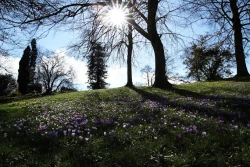
  • Rock Garden: This site originally started off as the marl digging site for building the Abbey. The Rock Garden itself was designed and created in 1923 around this site using the rocks unearthed on the estate and planted with alpines and trees for year-round interest. There are carpets of Crocus tomasinianus in spring followed by Cyclamen coum. Tulipa sprengeri takes the centre stage along with numerous Primula denticulata that are planted around the series of ponds that are set within the rockery. 
  • Park Garden: The Park Garden is the mainly herbaceous perennials interspersed with Clematis on wigwams and Spring Bulbs. There is a spectacular display of Galanthus nivalis and Helleborus orientalis in Winter along the wall to the West followed by 15,000 tulips and wallflowers in Spring. The herbaceous perennials carry on for the remainder of the season. On the West side is a gently sloping border of spectacular specimen grasses including Cortaderia richardii, Stipa gigantea, Calamagrostis x acutiflora 'Karl Foerster' and Briza maxima. 
  • Bog Garden: The Bog Garden was created in 1912 from an area of the Great Pond that has silted up over time. Until the 1980s the area was dominated by ferns and willows. However, it has been open since and today it has a large range of plants growing in the deep mud beside the streams.  bright beginning to the year withLysichiton americanus. An array of colourfulPrimula candelabra, Primula bulleyana and Primula beesiana start the Summer along with various Iris sibirica cultivars. The Hosta and Ferns centre stage through summer. The Astible and Rodgersia planted in huge swathes look truly remarkable.
  • The Swirl: The Swirl or The Spiral Garden was introduced by Alice Kennard in 2015. It is inspired by a Penitential Spiral from Monastic times. These spirals were used for meditation by the Monks. If you follow the path you will wind through one spiral and into a second, exiting at the far end from which you entered without ever retracing your steps. The Swirl is planted with 10,000 tulips in spring which are lifted and wildflower seed is sown in relaxed and calming colours for interest through Summer and Autumn.
  • Kitchen Garden: This is one of the oldest parts of The Abbey. The walls of The Kitchen Garden date back to Monastic times. The Monks used this area to grow vegetables using the manure from the farmyard that stood between The Kitchen Garden and The Abbey. Three out of the four walls are Monastic and a Mr. Miles, during his short tenure of The Abbey during the 19thcentury built the South facing fourth wall. Mr. Miles made a significant contribution to the Kitchen Garden by building the Victorian glass houses which today house the grape vines that date from the same era.
  • Arboretum: In 1937 Geoffrey Roper divided a section from The Park garden that extended down to the main drive and created The Arboretum; a collection of fine trees and shrubs. Planting began almost a hundred years ago and today we have some of the finest specimens of Magnolia, Rhododendron, Hamamelis, Liriodendron, Halesia and Cornus. There is also a good specimen of Picea farrerii that came to Forde Abbey from Burma.
  • The Long Border: The Long Border runs along the edge of the Long Pond with an edging of Ham Stone path and is mirrored on the right running along the edge of a wall. The border is broken with Yews dating back to the 19th Century. The left of the border is planted purely with herbaceous plants with a fantastic selection of dahlias, whilst on the right is a mixture of Roses, Hydrangeas, flowering shrubs, and herbaceous perennials. The three cascades falling in line from the Great Pond through the Canal and Mermaid Ponds fill the Long Pond. 
  • Woodland Garden: The Woodland Garden is an area planted with Rhododendrons, Camellias, Azaleas, and Magnolias, densely underplanted with Erythroniums, Meconopsis, Primulas, Pulmonarias and Hosta. There are various meandering paths through the woodland that all lead to the Mount. At the far end of the Woodland Garden there is a statue of the Blacksmith and looking down the hill there is a marvellous view stretching through to the gates at the end of the Broad Walk. The Woodland Garden is at its best in Spring.
  • The Mount: The Mount is the highest point in the gardens and is designed from the West wall built in the 19th century and going towards the house. This part of the garden predominantly consists of mature trees, especially Calocedrus decurrens, Redwoods and Sequoia sempervirens. There are multiple beds densely planted with herbaceous perennials for year-round interest. There are marvellous views looking back towards the Abbey, across the ponds and the 160ft Centenary Fountain.

THE HOUSE

  • The Chapel: As a chapter house, this would have been where the monks met to discuss the business and work of the day, a time of relief from their otherwise silent routines. The 12th century vaulting can still be clearly seen, looking much as it did in its earlier days. `In the 17th century, Edmund Prideaux converted the Chapter House into a Chapel. Inserting the carved oak screen in the centre of the room, together with the panelling. He retained the typical Cistercian central arch, with its two flanking side arches, which was formerly the entrance from the Cloisters.
  • The Cloisters: The Cloisters were used for walking and meditation by the monks and would once have formed a quadrangle to the Abbey Church, which stood where the front lawn is today. This one remaining side survives from the renovation pursued by Thomas Chardin about 1520, although his work on the Cloisters was left unfinished. It was rather more elaborate than the earlier construction. It can be seen by the 13th Century facing that has been left exposed by Chard in one of the bays. This is the remains of the Lavatorium where the monks had to wash their hands before entering the refectory whose doorway is immediately behind. 
  • The Monks Dormitory: In the monastic times this was 160ft long, stone-flagged gallery at twice its present width and open to the roof, exposing the massive oak trusses. Each monk would have had his own private cubicle, bounded by a screen of wood panelling, 8ft. tall, separating him from his neighbour. Within his cubicle there would have been his simple bed, a desk for his reading and a candle in his window. Two rows of such spartan cubicles would have flanked a central walkway, with only the slight sound of monkish footsteps to disturb the silent contemplations of their occupants.
  • The Saloon: The Saloon holds the Mortlake Tapestries on its walls; they are the most important works of art in the Abbey. They are woven from the cartoons painted by Raphael, that are now on display in the Victoria and Albert Museum. Blocked medieval windows and main roof trusses from the 14th century still exist in the Saloon, although the windows are hidden behind the resplendent Mortlake Tapestries. The impressive plaster ceiling is the finest in the house. The ‘beams’ were formed on lathing, ‘woven’ like a basket, so the plaster is not too thick, and most of the enrichment was carried out by craftsmen lying on their backs on scaffolding in situ. 
  • The State Rooms: Edmund Prideaux added these rooms in the mid-17th century, as parts of his ‘Piano Nobile’, or reception suite, for the Saloon. They lie directly above the Cloisters and may well have been designed to balance the Great Hall on the far side of Chard’s Tower. The Prideaux rooms both have intricate plaster ceilings, devised, and moulded by the same hands as on the Grand Staircase ceiling, with the same degree of inventiveness.
  • The Upper Refectory: When the Cistercians originally broke from the Benedictines, they were strict vegetarians. However, during the reign of Henry VII, the rules of diet were relaxed by their Order, and they were permitted to eat meat. While many were eager enough to become carnivores, other frowned upon the dispensation, saying no good can come of it. To avoid the two dissenting groups at Forde Abbey eating together, the Upper Refectory was therefore built for the meat eaters, directly above the original refectory.

Facilities

  • Parking: Free parking available. 
  • Food & Drinks: Café serving lunch, light bites, cakes and bakes.
  • Gift Shop: Browse a broad range of gifts including; toys, books, toiletries, unusual decorative items, Forde Abbey souvenirs and condiments.
  • Eeles Pottery: Each year the Eeles Family exhibit and sell beautiful and unique examples of their work at Forde Abbey. Situated in the Old Potting Sed, it is manned by members of the Eeles Family.

Price

Price: Paid

Price Details

Admission Prices

  • Adult: Gardens £15.00 / House & Gardens £19.00
  • Child (5–15 yrs): Gardens £6.00 / House & Gardens £6.00
  • Group Ticket (min. 15): Gardens £12.50 / House & Gardens £15.00

Memberships

  • Single Membership: £43.50
  • Double Membership: £87.00
  • Family Membership (2 adults and up to 4 children): £100.00
  • Child Membership (5yrs - 15yrs): £10.00

Pricing URL: https://www.fordeabbey.co.uk/your-visit

Birthday Parties

Offer Birthday Parties: No

  • Gardens: 1st March–31st October - 10:30am–5:00pm (last entry 4:00pm)
  • House: 29th March–30th October - 12:00pm–3:30pm (Tue, Wed, Thu, Fri, Sun & Bank Holiday Mondays). Closed Mondays (except BH) and Saturdays.
  • Abbot's Table Café: 1st March–31st October - 10:00am–5:00pm
  • Forde Abbey Nursery: 1st March–31st October - 10:30am–5:00pm
  • Gift Shop: 1st March–31st October - 10:30am–5:00pm

Address: Forde Abbey and Gardens, Estate, Chard, UK

Post Code: TA20 4LU

Council: Dorset

County: Dorset

  • From the M5: Leave the motorway at Junction 25 (Taunton) and take the A358 to Chard.
  • From the A303: Leave the A303 at the turning for Crewkerne and join the A356. At Crewkerne take the A30 towards Chard.
  • From Exeter: Take the A30 to Honiton and then the A35 to Axminster. In Axminster take the A358 towards Chard.
  • Using Public Transport: Getting to Forde Abbey by public transport is a challenge but not impossible. However, combining a trip to Forde Abbey with a walking tour of the area, whether a short one day excursion or as part of a longer holiday, is always a very enjoyable experience and public transport can be used both to get to the area and for travelling locally. There is a series of well signposted and maintained footpaths nearby and Forde Abbey itself acts as the starting point for the 90 mile long Jubilee Trail.

5

0 Reviews

Rating breakdown

5
80% Complete (danger)
0
4
80% Complete (danger)
0
3
80% Complete (danger)
0
2
80% Complete (danger)
0
1
80% Complete (danger)
0

Get the best blog stories into your inbox!