
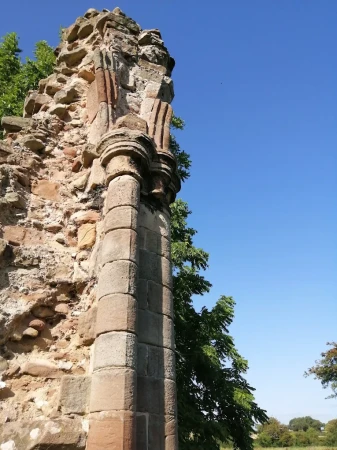
Croxden Abbey

Description

Croxden Abbey the 12th century abbey at Croxden was home to 70 Cistercian monks at its peak. Although converted into a farm after its suppression in 1538, the remains are impressive, including towering fragments of its 13th century church, infirmary and 14th century abbot's lodging.

Croxden Abbey was begun in 1179 after Bertram de Verdun, an important local nobleman, granted land to a community of Cistercian monks in 1176. At its peak in the 13th century, Croxden housed about 70 monks. Following the monastery’s suppression in 1538 the abbey and its lands were converted into a farm.  

Free Entry. If you are looking for Best place for day out with kids and families then this is the perfect destination offering fun, adventure, and unforgettable memories for everyone.

Features

  • Paid
  • Host birthday parties: No

Features

  • History of Croxden Abbey: Croxden Abbey was begun in 1179 after Bertram de Verdun, an important local nobleman, granted land to a community of Cistercian monks in 1176. At its peak in the 13th century, Croxden housed about 70 monks. Following the monastery’s suppression in 1538 the abbey and its lands were converted into a farm. The visible remains today include parts of the abbey church, which was one of the most elaborate churches of any Cistercian abbey in England, together with the infirmary and abbot’s lodging.
  • Foundation and Early History: In 1176 Bertram de Verdun, Lord of Alton (d.1192), granted land in Croxden and Cotton (a few miles north) to monks from the Cistercian abbey of Aunay-sur-Odon in Normandy, to found a monastery. The reforming Cistercian monks followed a strict, literal observance of the Rule of St Benedict, written in the 6th century, and endeavoured to be self-sufficient communities, favouring remote, isolated sites.
  • The monks moved from Cotton to the more remote site of Croxden in 1179. The church was built first, followed by the buildings around the cloister. Completion and further enlargement of the buildings followed under the leadership of Abbot Walter London (1242–68).
  • Decline and Suppression: The abbey flourished in the 13th century, when it may have supported as many as 70 monks, but during the 14th century the community suffered from the effects of crop failure, cattle disease and plague.
  • Henry VIII eventually suppressed the abbey in 1538, ordering the removal of the church roof to prevent the monks from using the site. The abbey and its lands became part of a farm. The cloister became a yard and a track was cut across the church, bisecting the site. The ruins were taken into state guardianship in 1936.

Facilities

  • Parking: There is very limited parking in the layby at the site entrance. Please avoid parking on the grass verges or blocking access for local residents.
  • Food & Drinks: A selection of pubs and cafes can be found in the surrounding areas.

Birthday Parties

Offer Birthday Parties: No

Open daily.

Address: Croxden, Uttoxeter, Staffordshire ST14 5JG, UK

Post Code: ST14 5JG

Council: East Staffordshire

County: Staffordshire

  • Road Access: 5 miles north-west of Uttoxeter off A522.
  • Bus Access: Closest service is Phil Smith 185 to Hollington (Fri only). Otherwise First 32 to Fole or First 32A to Alton then 2 1⁄2 miles walk.
  • Train Access: Uttoxeter 6 miles.
  • Bicycle Access: Find this site on The National Cycle Network.
  • Parking: There is very limited parking in the layby at the site entrance. Please avoid parking on the grass verges or blocking access for local residents.

0.00

0 Reviews

Rating breakdown

5
80% Complete (danger)
0
4
80% Complete (danger)
0
3
80% Complete (danger)
0
2
80% Complete (danger)
0
1
80% Complete (danger)
0

More Day Outs in East Staffordshire

Get the best blog stories into your inbox!